Probably a very interesting collection of articles, however i have no acces to them.
http://www.sciencemag.org/content/333/6047/1235.full?rss=1
Carousel of books I enjoyed reading
Monday, October 3, 2011
Wednesday, September 28, 2011
Developing standards in synthetic biology
A very interesting presentation on standardisation in syntheticbiology.
Imagine a world where:
Standards are vital
for the normal functioning of society
The presentation can be found here : www.dsrc.rpi.edu/ presentations/RPITalk_2.pptx
Imagine a world where:
- Each company made its own incompatible nut, bold and screw?
- Every town had its own way to measure time.
- Every internet provider used different protocols for the ‘TCP/IP’ stack, email, web etc.
- and so on
The presentation can be found here : www.dsrc.rpi.edu/
Mimicking cells with transistors - MIT News Office
Mimicking cells with transistors
Tuesday, September 20, 2011
Sunday, September 18, 2011
NSF : A Call to Arms for Synthetic Biology
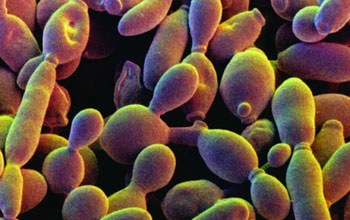
Scientists have replaced all of the DNA in the arm of a yeast chromosome with computer-designed, synthetically produced DNA that is structurally distinct from its original DNA to produce a healthy yeast cell.
Read more : http://www.nsf.gov/news/news_summ.jsp?cntn_id=121639&WT.mc_id=USNSF_51&WT.mc_ev=click
Tuesday, September 13, 2011
workshop book : Synthetic Biology International Workshop – Berkeley 2011
Here you can find the workshop book of the :
“International Synthetic Biology Workshop: A Bio-based Future”
29-31st of August 2011http://synbio.ku.dk/english/past_events/berkeley_2011/Monday, September 5, 2011
Another introduction to Synthetic Biology
An introduction to Syntethic Biology posted on youtube by The university of Bristol
Friday, September 2, 2011
What are the best online synthetic biology resources?
Some good resources on Synthetic Biology : http://www.quora.com/What-are-the-best-online-synthetic-biology-resources/answer/Alex-Yang-1
Saturday, August 27, 2011
The Brown Lab's complete guide to microarraying for the molecular biologist.
I found this one http://cmgm.stanford.edu/pbrown/mguide/ while looking for articles on how to build your own DNA micro array. The software download link appears to be broken. However, I think you can get the software here http://en.bio-soft.net/chip/ArrayMaker.html
Sunday, August 21, 2011
Synthetic Biology Workshop Keynote: J. Craig Venter on Synthetic Biology at NASA Ames
The synthetic biology initiative at NASA Ames is designed to harness biology in reliable, robust, engineered systems to support NASA’s exploration and science missions, to improve life on Earth, and to help shape NASA’s future. Read More : http://syntheticbiology.arc.nasa.gov/
Wednesday, August 17, 2011
Tuesday, August 16, 2011
Visit to the design museum in London. Stumbled on E chromi
Recently I visited London and went to the design museum. There i stumbled on E chromi, one of the entrants of the 2009 International Genetically Engineered Machine Competition (iGEM). In the design museum E. chromi was an entrant to the The Brit Insurance Designs Awards, "the Oscars of the design world,"
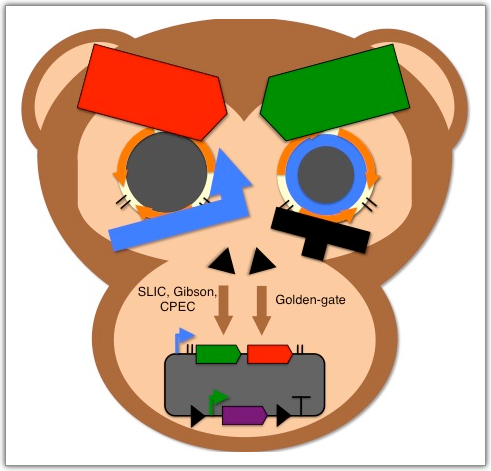
j5: automated DNA assembly software
I have been playing around with this tool, quite fascinating. More on it here : http://www.sciencedaily.com/releases/2011/08/110816133115.htm
Excerpt "The j5 software package is a Web-based computer application that automatically designs and optimizes state-of-the-art DNA construction protocols," Hillson says. "Within minutes it can determine the optimal flanking sequences that should be attached to each DNA part to produce the desired recombinant DNA at the least expense, in a manner that is executable by hand or robotics."
Friday, June 24, 2011
MIT Technology review : Genes Controlled with Light
Read more : http://www.technologyreview.com/biomedicine/37876/?p1=A1
Synthetic Biology Fact Sheet - Office of Naval Research
Interesting stuff and future applications here (http://www.onr.navy.mil/en/Media-Center/Fact-Sheets/Synthetic-Biology.aspx) :
The Office of Naval Research (ONR) Synthetic Biology Program aims to develop transformational approaches to multiple naval application areas. Products will include living organisms with the capability to produce, deliver, detect and respond to compounds, or to provide command and control to nonliving miniaturized devices.
Secure and sustainable production of high-value materials, such as energetic materials or future naval fuels, may be achieved using synthetic biology. For example, both bacteria and plants have been engineered to use sugars, carbon dioxide and sunlight to produce intermediates for the production of TNT and TATB (triaminotrinitrobenzene, an aromatic explosive).
Living sentinel species have also been generated, which may allow ‘plug and play’ approaches for design of systems that can sense and respond to threats. The illustration above shows leaves of plants that have been programmed to respond to the detection of TNT vapor by turning white. The color change can be detected using remote spectral imaging systems.
Part of ONR’s program is centered on developing more of the synthetic biology tools needed to advance the field, such as methodology to produce large, multigene sequences, stimuli-responsive regulatory sequences and methods for rapidly adapting cells to perform new functions.
As ONR learns more about how living organisms work and how their functions are controlled at a genetic level, it will expand the repertoire of functions and pathways available for designing new organisms. Ultimately, engineered cells may be used to control and make decisions for a non-living nano or micro device through the cells’ processing of environmental information and translation into signals interpretable by that device.
Thursday, June 2, 2011
USA Today : DIY 'biopunks' want science in hands of people
What if you could genetically engineer a yogurt bacteria in your basement that turned blue in the presence of toxic heavy metals such as chromium and cadmium that are known to make people sick? .... Read more here : http://www.usatoday.com/tech/science/2011-06-01-science-biopunk-hacker_n.htm
Saturday, May 28, 2011
Subscribe to:
Posts (Atom)